
Dave-H
Content Type
Profiles
Forums
Events
Everything posted by Dave-H
-
That was my experience too, but be aware that some extensions may not work correctly if just moved from 360Chrome to Supermium. You might have to uninstall and reinstall them. Just a quick recap on my experience with Supermium 121 so far, compared with 360Chrome. It works fine, albeit rather slowly on my system. The main issues I have with it are that it closes the browser when you close the last tab, something that drives me absolutely mad! I have fixed that with an extension, but why it can't have a setting to prevent that, like 360Chrome does, is quite beyond me. Also, I don't like the fact that there's no way to get bookmarks and external links to always open in a new tab, as there is on 360Chrome. I guess there's probably an extension for that too, but why it isn't built in as a setting is again a mystery. It really annoys me when things keep always opening in the same tab. I would love to make it all a bit 'smaller'. It's all a bit too large on the screen. Yes, I can zoom websites to a smaller size, but the GUI remains the same of course. Changing the font size settings doesn't seem to do anything. It's certainly deeply linked to Google, as I guess Google Chrome is too. I'm not too worried about that personally, but I'm sure a lot of people are!
-
 If this starts up again, this thread will be locked too. Back off please.
 -
You can post them here for interest of course, but they really need to go directly to the developers on github.
-
Thanks, that's good to hear, although I will stick with 121 for the moment! I still can hardly believe that a browser with the latest Chromium version will actually work on XP. It's far from perfect, but the fact that it works at all amazes me!
-
Not here please, as it's off-topic.
-
Sorry, I haven't had a chance to look. I suspect that it isn't actually an individual file, it's probably hidden inside another file. I did look for disk.sys and scsidisk.sys with no luck.
-
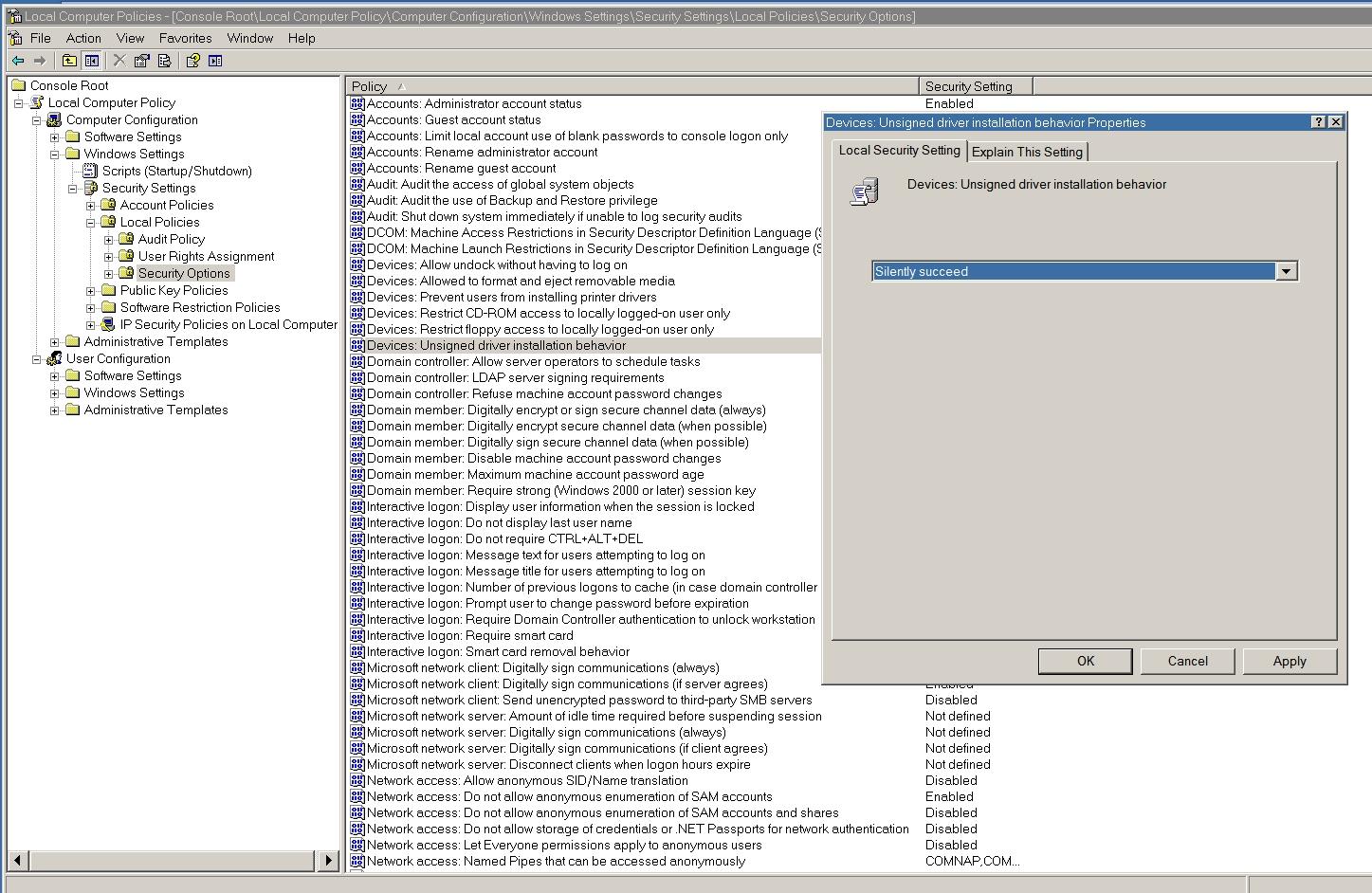
That was really quite worrying, to see so much missing there on my system! It turned out that three of the four files which should have been in the \system32\GroupPolicy\Adm folder were not there! Only wmplayer.adm was there, conf.adm, inetres,adm, and system.adm were not. I have no idea why that would have been! I've restored them, and it now looks much better. I found the setting specified, and set it to 'enabled' and 'ignore', but again no difference, the wretched prompt still pops up when I mount a drive. One thing I have done as a test is restoring the three files I changed back to their originals, so things should now be standard. I was amazed (and annoyed) to find that the 'unsigned driver' prompt is still popping up! It can't be because of the files now, as they are the originals, so why is it still querying the driver?

-
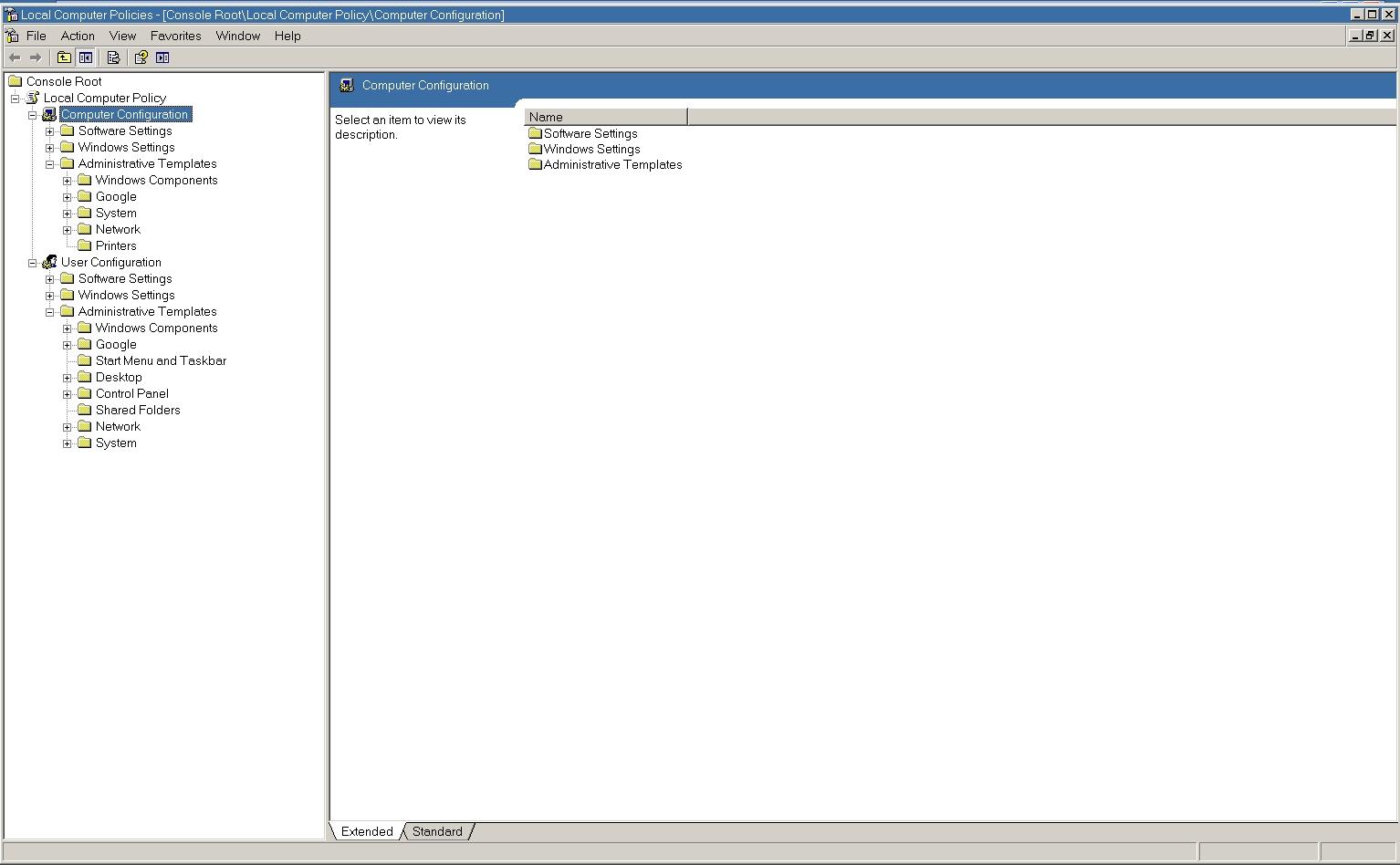
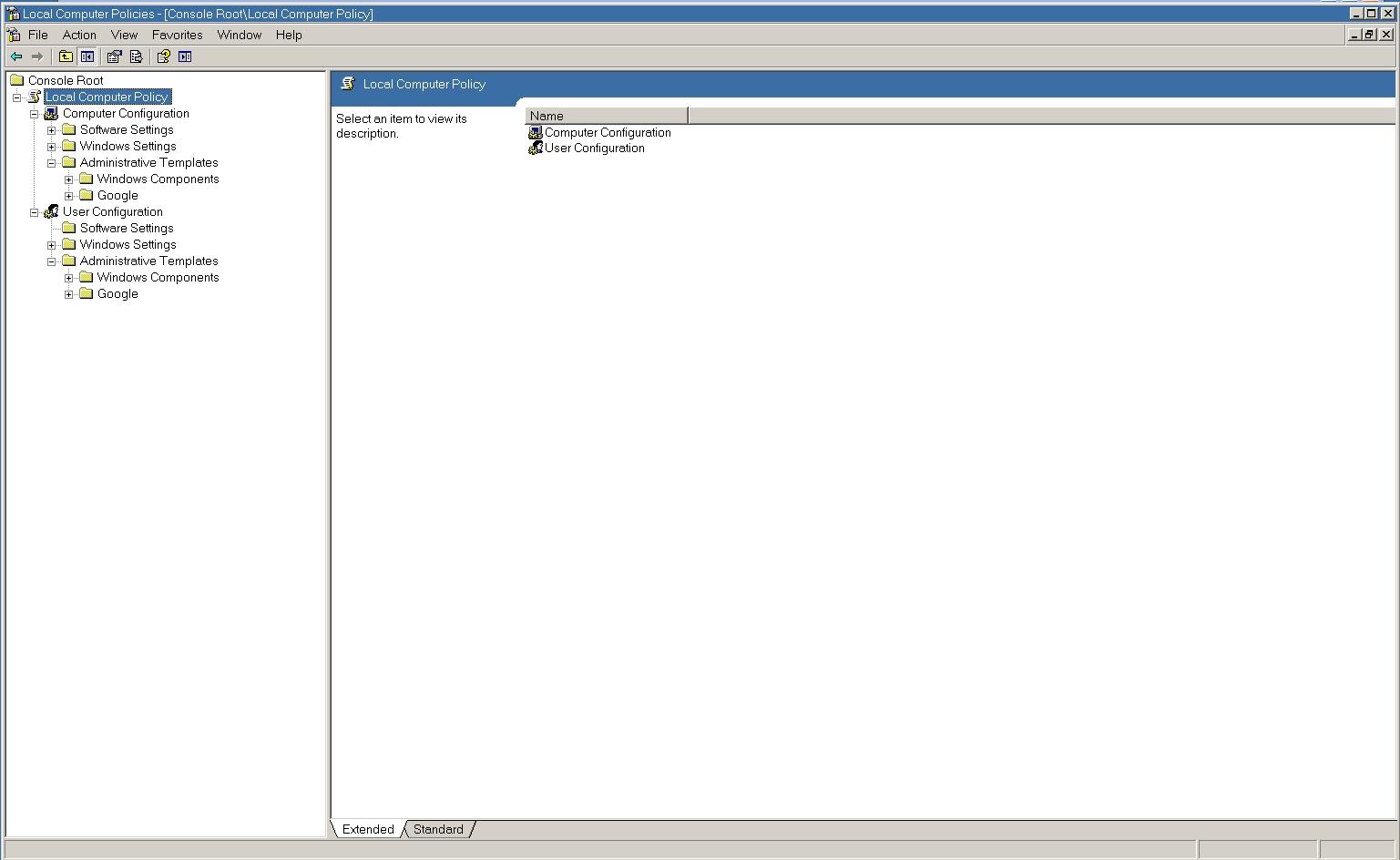
'User Configuration' and 'Administrative Templates' are expanded on the screen grab I sent. The only options under 'Administrative Templates' are 'Windows Components' and 'Google' The 'System' option isn't under 'Windows Components' either.
-
As you can see, that option is not there on my system.
-
Off-topic, but I've still got my original PC, from 1993, so not quite as old as yours! I run dual boot Windows 95 and Windows NT 3.1 on it.
-
Thanks both. Yes, that System Properties option is actually mentioned in the article that @jaclaz linked to. I tried using it, made absolutely no difference. I couldn't find the GPEDIT option mentioned in the article, it doesn't seem to exist on my system. The nearest I found was this - It also made absolutely no difference, the wretched warning message still pops up! I guess it's because there are actually 'alien' files on the system transplanted from a different OS. When prompted whether I want to overwrite the 'alien' disk.sys file or not, the file it's offering to replace it with is a temporary file in the system32/drivers folder. This has a temporary name, and presumably it's renamed to disk.sys when it's copied. Where is the system getting this file from? Presumably there's some hidden system files database somewhere. If I can change the file there to the Server 2003 one, would that stop the replacement offer?
-
Thanks, but does the Driver Signature Enforcement Overrider work on XP? All the documentation says Vista minimum. Is it actually a signature problem anyway? XP is just saying that the Server 2003 disk.sys file can't be verified to work with XP. Drivers which are just unsigned are not normally a problem, you can override that, and it's remembered, this isn't being remembered.
-
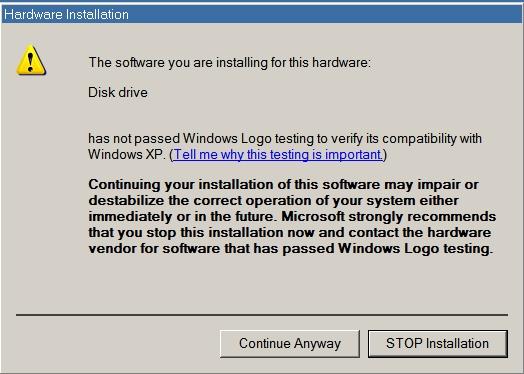
@Andalu @jaclaz Back again! I'm still getting this annoying pop-up whenever I mount one of the eSATA connected disks. I thought I had managed to get rid of it, but sadly not. I assume it's coming up because the disk.sys file was changed to the Server 2003 version, which the system thinks isn't compatible with XP. If I go ahead and install the driver it asks if I want to overwrite the newer disk.sys file, and I thought that if I said 'no' that would be it, but it's obviously not being remembered as I'm having to do it every time I mount the disk, and this is happening with both the disk connected to the Asmedia card and the one connected to the Silicon Image card. If the disks are already powered up and connected at boot time, it's fine, I don't see the pop-up, it only happens if I 'add' them while XP is running. Is there any way of stopping this happening?
-
OK, I think I'm happy with the configuration that I've now got. Sadly it doesn't include the Syba board, which has turned out to be rather a waste of money, but I will stick it in the loft for possible future use! If it can't coexist with the Asmedia board, then it's no use. I did try it along with the original PCI-E Silicon Image board, and that worked fine, but that's no good of course. What the problem is I can only guess at, it looks like some sort of resource conflict in the BIOS, but as the cards are on different buses, and moving the Syba card around to different slots made no difference, it's a bit puzzling. I can't move the Asmedia card, as it's in the only slot it can use. Anyway! I now have the original Silicon Image card back in, the Blu-ray drive is now connected directly to the motherboard, which is better for recovery operations anyway, and the eSATA card has the fixed archive drive and the removable internal caddy drive connected to it. The Asmedia card now only has the backup drive external enclosure connected to it. I will carry on using it in that configuration and see how it goes. Obsessively running chkdsk all the time might be not the thing to do. I will carry on using it as it is, and not worry unless and until I find I'm getting errors reported when backing up, or chkdsk starts running automatically because there are errors. Sorry this has been so long-winded, and drifted off-topic, and thanks everyone, especially @Andalu and @jaclaz for all the help, much appreciated! I will come back if (when) I start getting problems! Cheers, Dave.
-
Thanks, but there's nothing even resembling that setting in my BIOS. I have a server motherboard, so maybe they don't have such options there as they are more critical of correct configuration and resource usage and sharing. Thanks both, but I've now put the machine pretty much back as it was before, and restored a copy of the registry from before this happened. It still said it was unactivated, but when I tried a manual online activation again, this time it worked! Having had to go through the tedious business of reactivating Office on the phone when I changed my motherboard, I was very grateful not to have to go through that again!
-
Thanks again @Andalu and @jaclaz ! I'll say straight away that the following is now off-topic, as it's nothing directly to do with using a GPT disk in Windows XP. It has come about because of trying to do this, though. As a moderator I should set an example of good forum discipline of course, but I hope you will indulge me. Should it lead to a lengthy off-topic discussion, I will break it off into a new thread. As I said, the Syba card arrived today. I put it in the machine in place of the Silicon Image eSATA card I've been using for many years, and connected the internal archive drive and the Blu-ray drive to it. My first disappointment was that although both devices were apparently detected correctly, there was still no sign of the Blu-ray drive being available as a boot device in the BIOS. That I can live with, but there were two far more serious problems. The first, and most serious, was that the machine would no longer boot! It showed the BIOS screens of the two cards, first the Syba one, then the Asmedia one, and then just hung and won't go any further. If I removed the Asmedia card, it booted fine! If I put the Silicon Image PCI-E card in place of the Asmedia card, it boots fine. It won't boot with the Asmedia card and the Syba card in place, though. I've tried moving the Syba card to different PCI slots, and it makes no difference, the motherboard just hangs if both it and the Asmedia card are present. I then did boot up without the Asmedia card in place, and installed the Syba drivers for XP, which worked fine. I then went into Windows 10 and that found a driver and it worked fine. I then tried to go into Windows 98, and it wouldn't boot. It goes past the splash screen, but then instead of going to the desktop, it just sits there on a flashing cursor and then reboots. It will go into Safe Mode, and I used that to remove the old Silicon Image card from Device Manager, as I thought that might be causing the problem. No difference, it still reboots instead of loading the desktop. So, all in all, a bit of a disaster today! I've wasted quite a bit of money if I can't use that Syba card, but I didn't anticipate any of this of course. Just to add insult to injury, my Windows XP is now unactivated because I changed the hardware! I've put everything back as it was before, and it's still unactivated. Activation over the internet no longer works of course! Oh dear.
-
Wow, that is an amazing thing!
-
Thanks @Andalu ! Sorry, I did understand your suggestion before, it just seemed a bit of a long-winded thing to have to do. You're saying that I should use the Asmedia driver on the on-board Intel SATA ports? As the drives all work fine connected to them as they are, I guess this is just to determine whether the problem is with the Asmedia card itself or with its drivers? As I said, I've now installed a different Asmedia driver for the card, both on XP and 10, and it made no difference on either. That would seem to indicate that it must be the card, it just 'doesn't like' those disks for some reason. I made the 500GB disk as much like the 3TB disk as possible, making it a GPT disk, putting a single primary NTFS partition on it, and it's even a disk from the same Seagate Barracuda series as the 3TB disk. The two disks couldn't have been any more similar, apart from the capacity. The 500GB disk produces constant controller errors on writing (not on reading it seems) the 3TB disk doesn't. Apart from the 500GB disk being faulty, which I'm pretty confident that it isn't, I can think of no explanation for that at all. Anyway, I don't want to actually use the 500GB disk, so it's not really a problem. The important thing is that the 3TB disk works properly, but I just don't like 'unexplained' problems like that!
-
Thanks @D.Draker and @jaclaz ! I do need a PCI (not PCI-E) card with Windows 98 drivers to replace my Silicon Image card, but good to know what's available. My Syba card has now arrived, I'll let you know how I get on with it!
-
Oops, yes I must be going blind, it has indeed got two internal SATA ports! If the card I've ordered is successful, I might well buy that one as a spare! Thanks for the heads-up.
-
Thanks, but that card on eBay doesn't have two internal SATA ports on the card, which is what I want. One of them is an external port. I'm pretty sure that the Vantec ST300 Silicon Image based eSATA card that I was using before is only SATA 1 too, so I won't notice any difference! I'll let you know how I get on when the card arrives, hopefully later today. Cheers, Dave.
-
Another update. I've now updated the drivers for the Asmedia card, to version 3.2.0.0 on XP, and 3.2.3.0 on Windows 10. As you say @Andalu the drive now no longer appears in the 'safely remove hardware' applet, although the Blu-ray drive still does appear. That's not really an issue, as I can still use 'HotSwap!' to 'eject' the drive. I've got a card coming hopefully tomorrow to replace the Silicon Image eSATA card I was using for the backup drive before, and for the internal archive drive. It's one of these, and it's costing me a bomb to get it shipped from the States, but I hope it will give me two internal SATA connections that I can use for the Blu-ray drive and the internal archive drive. It claims to have drivers for Windows 98, I will not be pleased it that turns out not to be the case! The card even has an IDE connector on it, but I don't think I'll need that as my board already has one (it's being used for an ancient DVD-RAM drive!) When the backup drive is the only thing connected to the Asmedia card, things will hopefully be simpler. Changing the drivers doesn't seem to have made much difference, although the chkdsk readouts are pretty clean now between XP and 10. The crunch will come when I write a lot of files to the drive again, I suspect! I'm actually not going to put my phone backup back onto the drive again, I'm going to use another drive, very likely just a USB memory stick, to back that up. It is after all actually a backup of a backup, just in case the phone dies, or I lose it, and the original backup drive dies! I'm almost more puzzled now as to why the other 500GB drive is not working with the card, although this is a bit off-topic, of course. I'm almost 100% sure that there's nothing wrong with the drive, and in fact another drive produced the same result. Further tests seem to indicate that reading the drive is fine, blisteringly fast and no errors. Writing is the complete opposite, very slow and masses of errors in the event log. I was clutching at straws that updating the drivers might help this, but it hasn't. It's the same in Windows XP and Windows 10, so it must be something quite fundamental, and yet the 3TB drive shows no controller errors at all! I cannot explain that.
-
OK, a bit of an update! I decided to delete the backup of my mobile phone from the backup drive. Apart from anything else, over 20000 image files are duplicated on the drive, as they are both in their original folders, and also in the phone backup, which includes the phone's SD card where copies of them are so that I can view them on my phone! The phone backup folders seem for some reason to be generating the vast majority of the chkdsk errors, and it's confusing as I don't know, if it says that a particular image file is corrupt, whether it's the copy in the original backed up folder, or in the backed up phone backup folder! Having done that, the number of errors has drastically reduced again. I'm still getting clean chkdsk runs in XP which then show errors in 10 without even manually accessing the drive, and vice versa. The errors are not severe, no cross-linked files or anything like that, for instance in XP it keeps telling me it's deleting the index for a file called 'bootTel.dat'. If I allow it to do that, it's fine until I've been in Windows 10, and then the same error comes back in XP! That file has never been on the backup drive as far as I know, it seems to be a file that you might find in the root of the Windows 10 system drive, caused by a recovery operation, but nowhere else. That is another mystery! I was wondering whether to copy the phone backup back to the drive using Windows Explorer, just to see if the problems come back, which would exonerate QuickMirror as the cause of the errors. If I do that, my instinct would be to do it in XP, as that's what's really being tested. Incidentally, do we know for sure that the Windows XP version of chkdsk will work correctly with drives over 2TB, bearing in mind that Windows XP was never designed to use drives that big? Is it possible that the XP chkdsk is actually malfunctioning with the 3TB drive, and erroneously showing errors which aren't there, or even perhaps causing them? I guess the chkdsk from Server 2003 isn't worth trying?
-
The controller errors are a completely unexpected mystery. Why they should happen with two disks and not with a third disk I cannot explain. I will now do some mass file copying tests with Explorer, just to see if QuickMirror is causing the problem. I'm using 2.0.3.1 at the moment, with version 2.0.3.0001 of asachci32.sys and version 1.0.0.1 of ahcipp32.dll, I assume that's OK. I'm not using a riser, if you remember there was no room to physically get it in! The disk is connected to one of the SATA ports on the card, with a flying lead to an eSATA socket on a backplate. The SATA sockets on the card are apparently electronically identical to the eSATA sockets on the card, there is just a passive jumper switchover system between them.
-
Using QuickMirror has never shown any problems like this before, and the backup disk has always been connected via an add-on card, never directly connected to the motherboard. It could be that the Asmedia card is somehow inferior to the Silicon Image card I was using before, but surely that's not likely, as the Asmedia card is a much more recent piece of hardware. I will now try some file copying just using Explorer, and see if it produces the same result, just to try to eliminate QuickMirror as a possible source of the issue. The first thing I checked of course was the connections, but remember that it works fine with the 3TB disk, there are no controller errors, there are with the other two disks. All I'm doing is sliding one disk out of the enclosure, and then sliding another one in. Nothing else is being changed. I cannot explain this.