Leaderboard




Popular Content
Showing content with the highest reputation on 02/17/2026 in all areas
-
... Well, why? 1. 32-bit apps run perfectly fine on a 64-bit OS 2. Do you expect a huge performance boost if you ran a 64-bit variant of yt-dlp ? Well, this app isn't, say, a browser with a voracious RAM appetite; I've been using it on a 32-bit OS myself for close to a decade, never ran into memory issues... 3. The one practical advantage of running it under 64-bit, the ability to install the curl_cffi optional dependency (necessary to circumvent CloudFlare's antibot/AI filters on many popular services) is nullified under WinXP, because the lib it uses internally (curl-impersonate) requires at least Win7(8?) x64 ... In any case, this is probably a "no-can-do", because @nicolaasjan relies on a third-party CPython-3.11-win32 implementation to compile his 32-bit WinXP-compatible builds; specifically, this was a py3.11.4 "assembly" kindly offered by our Ukrainian member cmalex , which uses several DLL wrappers from OCA/Wine/ReactOS and it was provided solely as a 32-bit variant (which should cover probably 95% of XP users ) ... Regards.2 points
-
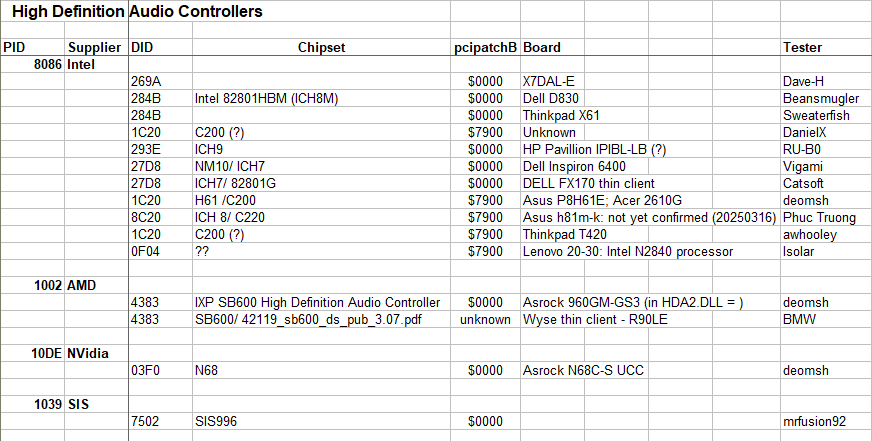
I asked Watler in August 2017 for help, running Windows 3.1. That time the actual version was Hdadrv6. Until December 2017 I had to test numerous versions, up to HDADRVJ. The only update regarding No Snoop was the SB600 HDA controller in my SB710 chipset. But luckily he added 'pcipatchB' to HDACFG.INI... Next a print-screen of my current list (ment for personal use): Watler was willing to develop his HDA-driver further, but he run out of machines to test. Now and then he has been 'seen' on www.win3x.org. Sadly he had to close his win3x forum (conforums stopped). But just before closing I managed to save most of the forum on the Wayback-machine: http://win3x.conforums.com/index.cgi?board=Pascal&action=display&num=1502071336 I had to test Interfaces too, maybe there is something 'into it' you can use with your timing problem?
 1 point
 -
Oh no, I was just interested in your opinion. You always have opinions about everything. Thank you for not ignoring!1 point
-
Many people told MSFN has fallen off the charts and the popularity went that so low since @D.Draker left, or someone forced him to leave (yes, there are reasons to consider that too). Page 5 is still good! I heard 8, 9. For me, it's rather closer to the top since I oftently search for @D.Draker's posts with Duck, so looks like they remembered my IP.1 point
-
No, the OP was on Supermium, at least what I understood, and now has to rely on a FF fork. https://msfn.org/board/topic/187750-sometimes-redirecting-to-spamgamble-site-when-accessing-msfnorgboard/#findComment-1285249 You again ignored the odd Golden Siamese cat icon instead of the usual icon of MSFN. It's odd! Is it their insignia?1 point
-
Well, I tried with a clean profile from Ungoogled 144. I know it's not the newest. You ignored the odd Golden Siamese cat icon instead of the icon of MSFN. Why? Any ideas?1 point
-
No Siamese language. No Siamese cats when searching with DuckDuckGo from Switzerland. But the icon of MSFN is weird! See the screen. Is the site really hacked by the Siamese hackers?
1 point
-
I offered MMX, SSE, SSE2 optimized opengl32, for machines like this. The softgpu only offers mmx (win95), with the other supplied opengl option requiring features not available on these older CPUs. But, the performance wasn't wonderful. There is a better option, and I'm sure some at MSFN have heard of it before. TitaniumGL doubles the performance of older Mesa OpenGL releases [6.5.4-7] (asm optimized for MMX, SSE, and SSE2). This is also true, if not more true, when using the SoftGPU provided opengl. TitaniumGL is meant to provide a conversion of opengl to direct3d, on machine that have hardware acceleration. But, when no hardware accel exists, it falls back on its own software rendering. I've tested its software rending, and it does double the performance. It can also be paired with Wine3d, like the Mesa opengl, included with softgpu. In the TitaniumGL download, it includes supporting files for Modern Windows, Win9x, and ReactOS. The modern release does not work with Win9x (even with KernelEx). The Win9x version works great. The ReactOS version works in Win9x, with KernelEx (maybe without it, as well), with a potential minuscule increase in performance (not verified, and hardly detectable; if real). Be sure to get the modern release of TitaniumGL, as the older ones floating around are half the performance. Also, be warned, don't get too excited. While the performance is doubled, that might not mean much in a less powerful machine. My Pentium-M 1.2Ghz machine still did not achieve real playable results with "Unreal Tournament GOTY Edition". At windowed 400x300, it really came close (Titanium -> Wine3d [haven't to tested opengl patches for UT]). But PSCXR went from unusable to usable windowed @640x480 (better @600x440) with graphics performance settings enabled, on the opengl plugin. For those using multiple core supporting versions of windows, the software (and hardware) renderer supports using these other cores. I assume, for hardware accelerated systems, the extra cores are utilized to increase performance of the opengl > direct3d translations. It has been noted, on machines with weaker GPUs, that the software renderer can outperform hardware "opengl (maybe not with wine3d)" acceleration (providing enough cores are available [support for 32 cores]). Again, it would be nice if a hack could achieve access to other cores, on bare metal Win9x installs. SIMD95 might improve performance, on CPUs that provide AVX (SSE/AVX for Win95) however it is intended for Virtual Machines. Not an excellent update, but I thought it worth mentioning. A nicely capable Core Solo (bare metal Win9x install) would probably provide a low expectation, but usable, software rendering experience. This might pair well the the emerging potential for HDA audio support (un-accelerated [emulated], like AC97).1 point
-
Never happened to me. Could be a redirect malware lurking on your PC? The one that edits HOSTS, for example.1 point
-
Wow! That was even more OT, random, and out-of-nowhere than even a lot of my posts!1 point
-
1 point
-
If we are to assume win32 still reads Supermium topic, probably better to post there, in Supermium topic, who knows maybe he will fix it, then. I already linked to a possible fix. https://msfn.org/board/topic/185045-supermium/?do=findComment&comment=12642071 point
-
1 point