



Everything posted by click-click
-
I run WinNTSetup on updated Win10 LTSC and W11 systems and use it to install, fix mount points, or add new systems to the BCD. I noticed an entry in the BCD that was not showing in the boot menu so I tried to add the entry again with WinNTSetup, but got the error. All of my local up-to-date systems where I tried this showed the same error. I then booted and used an 1809 LTSC VHDx from 2023-12 which did not give me an error. I deleted the old entry with bootice and the newly added entry now shows in the boot menu. I don't have a clue as to what was going on, or fully understand how bcdboot decides what to do. I ran the same command mentioned in my previous post and this time bcdboot had completely different verbose messages indicating Boot files successfully created. No WinVerifyTrust this time and I must wonder if any files actually get copied/replaced in the EFI partition when the stuff in z:\Windows is older. My guess is the missing boot menu entry for the system in the BCD was an indication of some type of corruption that was causing the error, even though booting the rest was not a problem. c:\>bcdboot Z:\Windows /s S: /l en-US /f UEFI /v BFSVC: ServiceBootFiles MuiOnly:n Res:y Fonts:y BootMgrOvw:n BootStatOvw:n DbgTrn:y SuspendBDE:n BootEx:y Offl ine:n BFSVC: Using EX bins because bootmgfw on ESP is 2023 already. BFSVC Warning: EX boot manager source file Z:\Windows\boot\EFI_EX\bootmgfw_EX.efi does not exist, failing grac efully to avoid block servicing. BFSVC: BfsInitializeBcdStore flags(0x0000021c) RetainElementData:n DelExistinObject:n BFSVC: VolumePathName for Z:\Windows is Z:\ BFSVC: SystemRoot is \Windows BFSVC: Opening template from \Device\HarddiskVolume13\Windows\System32\config\BCD-Template. BFSVC: Opening store from \Device\HarddiskVolume1\EFI\Microsoft\Boot\BCD BFSVC: Creating General objects. BFSVC: Creating Resume object. BFSVC: Creating MemTest object. BFSVC: Creating OsLoader object. BFSVC: OsLoader identifier: {04924720-269c-11f1-8157-dd48fe8b5d84} BFSVC: Removing duplicate entries. BFSVC: Create BOOTMGR object RetainBootDefault:n BFSVC: Setting {default} to {04924720-269c-11f1-8157-dd48fe8b5d84} BFSVC: Cleaning up debugger settings. BFSVC: Cleaning up hypervisor settings. BFSVC: Opening recovery store from \Device\HarddiskVolume1\EFI\Microsoft\Recovery\BCD BFSVC: Creating General objects. BFSVC: Create BOOTMGR object RetainBootDefault:y BFSVC: Setting {default} to {5ae80ebc-b03e-11f0-ad44-b5dd86473841} Boot files successfully created.
-
I assigned the ESP partition a drive letter so I could run the bcdboot from a command line intsead of with WinNTSetup and I got the same error: C:\>bcdboot Z:\Windows /s S: /l en-US /f UEFI /v BFSVC: ServiceBootFiles MuiOnly:n Res:y Fonts:y BootMgrOvw:n BootStatOvw:n DbgTrn:y SuspendBDE:n Offline:n BFSVC: Using EX bins because bootmgfw on ESP is 2023 already. BFSVC Error: WinVerifyTrust failed. Error code = 0x80092003 BFSVC Error: ServicingBootFiles failed. Error = 0x80092003 Failure when attempting to copy boot files. Seems like bcdboot will fail if the boot files from the EFI partition are newer than what is in the source ?\Windows
-
Here is a recent log file compared to an older one from 25-01 Creating boot files with BCDBoot.exe: Z:\Windows /s Y: /f UEFI bcdboot version: 10.0.26100.1 (WinBuild.160101.0800) bcdboot cmdline: Z:\Windows /s Y: /f UEFI bcdboot Return : -2146885629 Failure when attempting to copy boot files. Previously Creating boot files with BCDBoot.exe: Z:\Windows /s Y: /l en-US /f UEFI bcdboot version: 10.0.22621.3880 (WinBuild.160101.0800) bcdboot cmdline: Z:\Windows /s Y: /l en-US /f UEFI bcdboot Return : 0 Boot files successfully created.
-
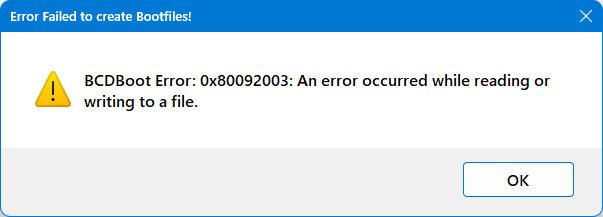
WinNTSetup no longer lets me update the BCD for UEFI when only selecting Boot drive and Install drive. I am getting msg below after applying setup. It will update the BIOS BCD, but not for UEFI one. I can boot all entries listed in the UEFI BCD in the classic boot menu. I haven't tried to change anything in the bcd for a while, so I don't know if any patch-tuesdays may have screwed things up. Bootice shows the active BCD without problems and I made a few name changes with it for the boot menu which worked fine. @JFX or anyone else, I need your expertise as to what I can try to fix this
-
FYI: Thw BSOD 07b was caused by the Intel RST driver. I had to add the Standard SATA AHCI Controller driver (mshdc.inf) to the VHD and then do a safe boot to remove the Intel Controller driver. After that, I was able to use the VHD in Vbox.
-
Version 19 no longer installs correctly on a 26100.1 system. The taskbar is hung and keeps looping on a msg to hold down ESC to keep it from loading, but that doesn't stop the hang. Killed explorer and ran the v16 install and taskbar is back to normal. It seems v19 is not downward compatible anymore.
-
Please read my OP entirely. Been there, done that. So what's the fix?
-
I don't think any of these apps will install drivers for a VM when converting (I've already tried some others). Since I already have a bootable working VHD there is no need for me convert unless there are apps that actually redo the storage drivers to work in a VM which I doubt. Finding the non-compatible driver(s) in the VHD is the problem.
-
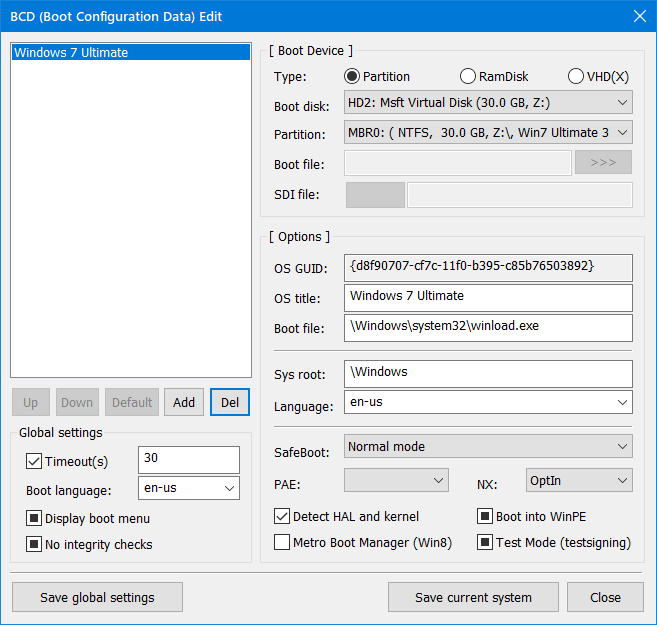
I have an updated W7 vhd that I boot loacally and I want to now use it in a VM (VBox). Since the BCD for booting was loacated outside of the vhd, I used Winntsetup to redo the BCD as shown below. The problem is, when I use the vhd in a VM, it starts to boot, but BSODs with 7b. When I try safe mode, it also abends. The last entry I see on the console before the BSOD is Classpnp.sys which is a storage class driver. So I assume I have a disk or controller driver installed in the vhd that doesn't work in a VM which may be causing the crash. @JFX or anyone else that might know how to resolve this, or something to try, please let me know.
-
If I remove a program from the start list, How do I get it to display again in the list? One my system, if I remove a program from the list, using it again later doesn't make it show up again in Start
-
I am using toolbars with StartAllBack. My quicklaunch toolbar is for my selected Apps. I have another toolbar that is created by Lenovo Power Manager which adds a useful Battery object. If I checkmark that toolbar to show in the taskbar, the SAB start icon tends to disappear under certain circumstances. It reappears in different situations such as mousing over the start icon or clicking on an empty space on the taskbar. If I uncheck the Power Manager Toolbar, none of this happens and the start icon never disappears. Is it possible for SAB to make thw start icon stick and not disappear? Happens too if the taskbar is unlocked.

-
No idea. I encountered the problem clean installing 26100.1 It's been turned off here ever since.
-
It's called Smart App Control and can be turned off in Defender or registry (0=Off 1=On 2=evaluation). Another half-baked attempt by Ms to tighten security that only gets in the way. https://support.microsoft.com/en-us/windows/smart-app-control-frequently-asked-questions-285ea03d-fa88-4d56-882e-6698afdb7003
-
I noticed SAB has a lot of duplicate icons in the tray icons config section. Sometimes three sometimes 2. They may or may not be checkmarked. The icons are visible only once on the taskbar. I'm using a quicklaunch folder on the taskbar if that matters. Running with SAB 3.9.5

-
@JFX or whoever knows I have and EFI partition that does not show a drive letter. For -syspart:{X} can I use -syspart:HDD-0:1 to get WinntSetup to update the EFI BCD there? i.e. d:\ThinApps\WinNTSetup\WinNTSetup_x64.exe NT6 -sysPart:HDD-0:1 -tempDrive:Z: -sysLetter:-C: -bcd:EFI -silent -setup Also, I can't remember why I used -sysLetter:-C: Should it not be -sysLetter:C:
-
I had Classic context menus enabled and this also worked for all desktop objects such as This PC . I recently inadvertantly unchecked this item in Make it top notch. I re-enabled it, but now all desktop items still show the new context menu instead of the classic one. All other items not on the desktop show the classic menu after it was re-enabed. How do I also get back classic context menu for the items on the desktop? I'm at 3.8.13 and using Windows 11 Pro 22631.4460 or Windows 11 LTSC 26100.2314 Edit: I'm not sure if StartAllBack ever supported the issue describe above, but I may have applied the following reg file previuosly, which got undone by unchecking the Startallback Context menu option. reg.exe add "HKCU\Software\Classes\CLSID\{86ca1aa0-34aa-4e8b-a509-50c905bae2a2}\InprocServer32" /f /ve The above command brings back the Classic contect menu for the Desktop items too.
-
Will a single license allow it to be used with different Windows systems on a multi-boot PC? My understanding is that the license is tied to the hardware, so if I use a multi-boot setup, the license will cover more than one StartAllBack install on that PC. Is that correct?
-
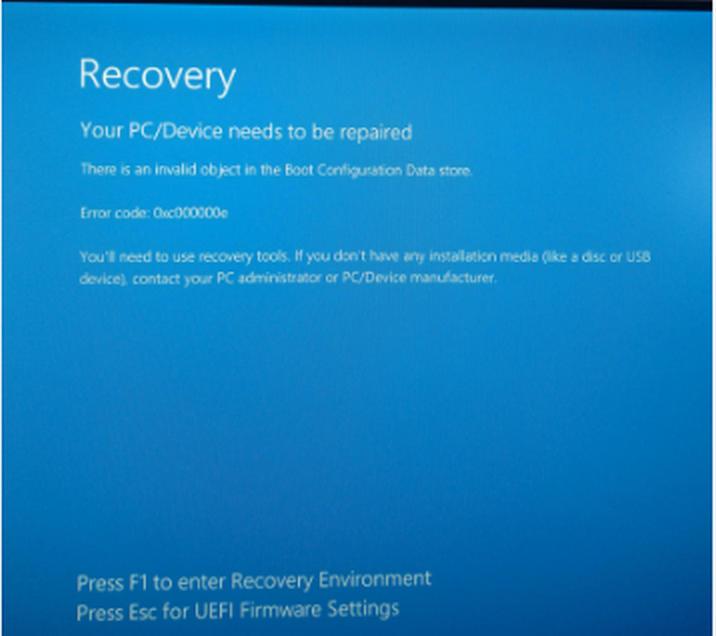
Did you not read my post above? CSM support for both with priority Legacy 1st and UEFI last. I tried a few things such as renaming the EFI directory as EFI_ and that is the only way up to now to make it use the BIOS boot BCD. As soon as I rename it back to EFI, it reverts to UEFI for the boot. The only other difference between the 2 flash drives is 128GB vs 256GB. The other thing I did was to restore the 100MB partition from the working 128GB flash to the other flash and that crashes. If I let WinNTSetup update the BCDs, the crash issue is resolved, but it still defaults to booting EFI
-
@JFX or anyone with and idea. I have 2 usb SSD flash drives that are set up to boot either BIOS or UEFI. Both have 2 partitons and the layout is 100MB FAT and the other NTFS for VHDs and wim files. I have a laptop that has CSM support and allows both BIOS and UEFI booting. The priority is Legacy first and UEFI 2nd. One flash works as it should and uses the BIOS boot BCD when booting. The other drive for some reason always ends up using the EFI BCD. I must have done something to that flash that causes this, but I don't know what. Both BIOS and EFI BCDs are pretty much identical on both flash drives. Any idea what's causing the boot process to use EFI instead of BIOS for that flash?
-
I don't know. Never tried it. I doubt it can be used for vhds
-
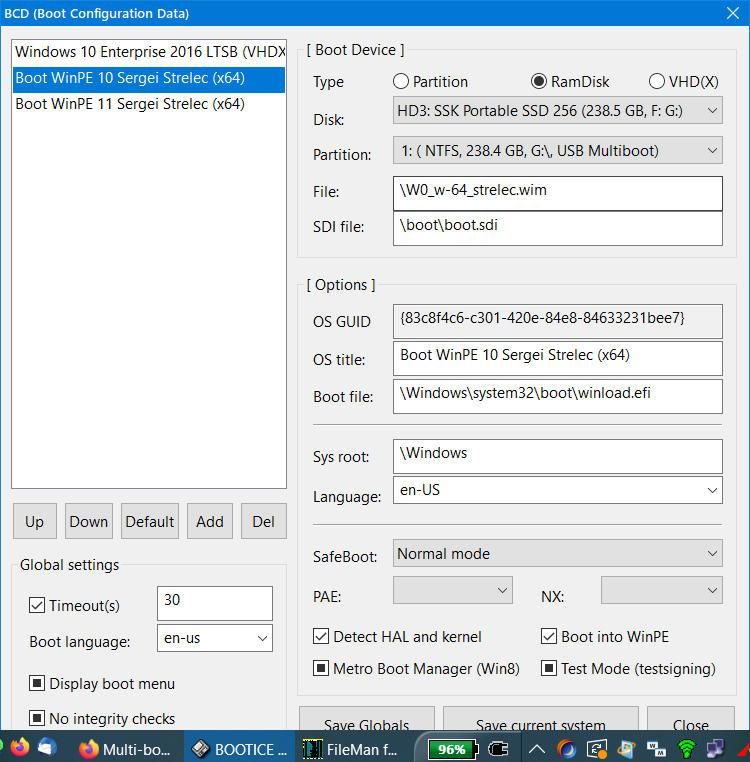
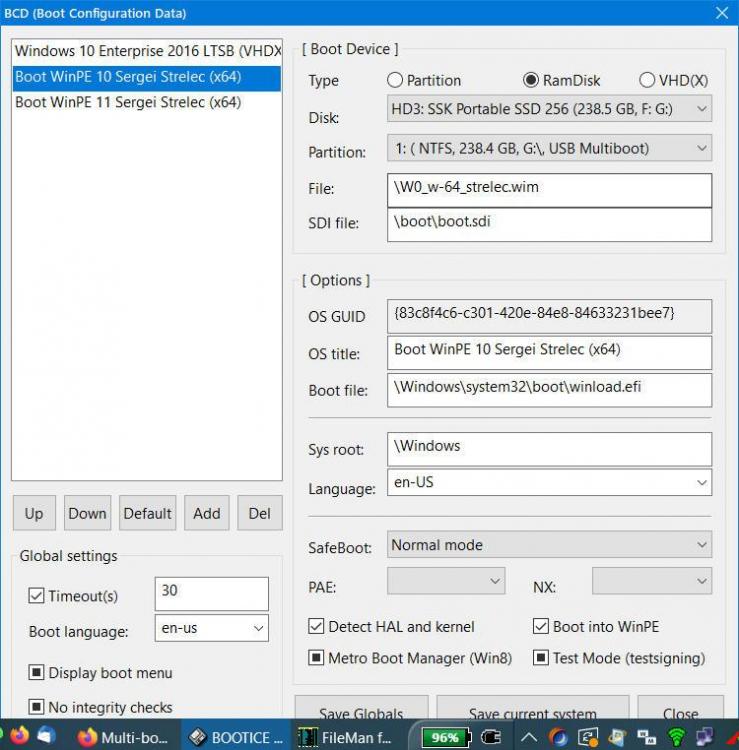
If the EFI BCD is configured correctly in the ESR partition, I don't see why the VHDs shouldn't boot. Unless you're doing this on different HW that require other drivers not installed in your VHDs. I don't know anything about svbus. If you mean the RamDisk option as an entry in the BCD, that is what I select to boot wim files.
-
VHDs only is not a problem. Same setup as what I did with the .wim files. Configure the bcd to point to the HD and partition with the VHDs. You can convert BIOS (MBR) drive to GPT (Windows Disk Manager), but the data on it needs to be deleted so make sure to backup the disk before doing the conversion. I only need UEFI for my new hardware. I won't be doing any conversions on my current disks.
-
From what I've been able to determine, all that is needed for UEFI is a 100MB FAT ESP partition to hold the the BIOS (if needed) and the UEFI system files used by the boot process. A recovery partition and an MSR partition aren't really needed. GPT also replaces MBR on that drive, but other drives can still be MBR. The windows BootMgr still works with a correctly configured BCD. I did a small test with the following layout: Hd1 (GPT), 100MB FAT ESP and 100GB NTFS with Strelec 10/11 wim files. Bootmgr lists both and both will boot. I will create a 3rd partition and use WinntSetup to install an OS there and see what happens. If what I've said is incorrect, please let me know what.
-
I am planning on getting a new laptop that that will only have the UEFI BIOS. It will be bare-bones without any OS with 2 SSDs. I understand a new partition layout will be required, but that's about all I know about UEFI. I've been living too long in the past. Previously, I would create and format an NTFS partition and apply my customized wim with WinNTSetup. What kind of partition layout do I need now before using WinNTSetup and will windows bootmanger still show a list of systems for multi-booting?
-