
Asp
Content Type
Profiles
Forums
Events
Everything posted by Asp
-
What about your DevicePath? Does 2000 machine use default still: http://support.microsoft.com/kb/314479/ HKEY_LOCAL_MACHINE\Software\Microsoft\Windows\CurrentVersion\DevicePath: REG_EXPAND_SZ:%SystemRoot%\Inf Try navigate to %SystemRoot%\Inf manually. That's already %SystemRoot%\Inf I don't let Windows go online by itself to find drivers, it never finds anything anyway. Will try to run the apps mentioned by jaclaz when I get back on the XP machine.
-
I have a simple cable with a header that fits on an IDE hard disk to USB. When I plug this into an XP computer, it sees the hard disk. My Win2000 PC however asks for a driver. There wasn't any with the cable, any idea what would work? Googling for generic things like "USB, hard disk, driver, Win2000" gives 5 million hits, so I'm hoping human intelligence is more targetted.
-
I'm pretty sure this is coming from Windows, I think related to autorun (though I have deactivated that). Anyway, I'll see if any other opinions surface. The problem is due to my not following the spec, by putting the drive vertical instead of horizontal. If I turn the PC 90 degrees, the disk ejects easily enough. But it won't fit into my desk like that. It worked fine for a few months until it started to stick on eject. Once the disk is in it plays or burns fine. Maybe I'll try to lube it though: Where exactly?
-
I have mechanical problems with my DVD drive, it often takes many "ejects" before the tray actually comes out. So I have a script that runs a soft eject 100 times when I need to change disks. However, this is slowed down as after a failed eject, Windows (Win2k) thinks there is a new disk inserted, and spins it up to read it for several seconds, before stopping and allowing the next eject attempt. Is there a way I can disable this? Preferably reversible, but I could live with it being off permanently.
-
Thanks, that's simpler, especially as I have a silly number of partitions and so each one has its own recycle folder. Nircmd empties them all.
-
Is there a built-in command that I can use to empty the Recycle bin in Win2k? I'd like to add that to batch files I use to clean up crap and make room. If not, a simple third-party utility?
-
Thanks! That solves it. I thought I'd have to reboot and change the time in BIOS, which would be pretty tedious every time.
-
I have an old laptop running XP with an almost dead CMOS. It's an odd battery, difficult and expensive to replace, so I'm just working around it. One problem is that the date and time can go completely off, years' off sync. I set Windows to use its Internet time feature to correct every hour, but this seems to throw an error if it's more than a year off, despite my setting the registry values: HKEY_LOCAL_MACHINE\SYSTEM\CurrentControlSet\Services\W32Time\Config\MaxPosPhaseCorrection HKEY_LOCAL_MACHINE\SYSTEM\CurrentControlSet\Services\W32Time\Config\MaxNegPhaseCorrection both to 0xFFFFFFFF, which is supposed to mean to always make the time correction. As above though it errors out if it's over a year. And I'm trying to do this to work automatically in a non-admin account (as my wife is the primary user of this, and I think it safer to do that, and want to automate it as much as possible). Unfortunately, Windows prevents non-admin accounts from doing almost anything involved with setting the time. I've tried a few third party time apps, but NONE of them work completely for a non-admin user. I like ( Dimension 4) but though I can set it to load and correct time at any interval in an admin account, under a non-admin account it can't retain its settings, and gives an error ("Corrupt data") if the computer date is more than a year late. I also tried ArgoSoft's timesync. This also had to be setup from an admin account, but it seems to work except it can't correct more than one year's error. So, is there a way to adjust time for a non-admin user? One not limited as to how much it can correct.
-
Thanks, but didn't work. I deselected both options, rebooted, but the icon comes back regardless.

-
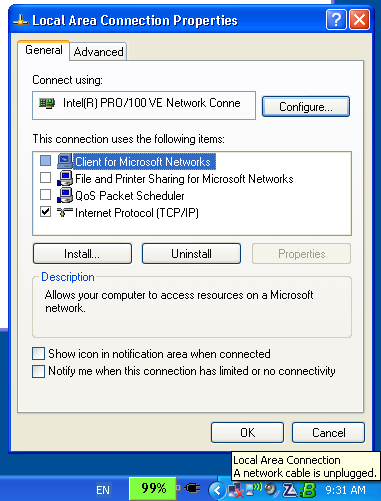
On my laptop with XP, which is normally connected via wifi, the icon labelled "Local Area Connection: A network cable is unplugged" always appears in the taskbar. I can go to Taskbar properties, select "customise" and choose it from the list of current items, and select "always hide", and it disappears. But on the next boot the **** thing is back and I see the behaviour has changed back to "Hide when inactive". I have set other items to always hide, and they stay hidden. How do I stop this from showing, while not stopping the hardware, of course, occasionally I do use the ethernet connection. But I don't need or want to be told that it's not plugged in. I can see that for myself.
-
Thanks to all for your comments. It's an X24. 128 MB soldered, one slot which comes with 128 MB, max accepted is 512. So I can replace the latter and get a total of 128+512=640 MB. And I've made the tweaks to Firefox to turn off phishing protection (I'm paranoid enough to not trust anyone online already). if you buy that old technology from a shop, surely, even more if you go for the highest capacity in that special slot, but I you can probably find some 256MB on eBay for very little money. No risk on that. A 256MB stick is much cheaper, but as there's only one slot, I'd only go to a total 374 MB, hardly worth the trouble. Also, I'm in Hong Kong now; still it's such hassle trying to buy stuff from the US -- they stick you for the currency, bill you for 1 lb shipping for something that weighs a few grams -- it would be an absolutely last resort. I can get a used stick locally for cash and take it back if it doesn't work. Going rate seems to be about US$37 for the 512 MB.
-
My ThinkPad laptop is a 1.13 GHz Pentium III, which came with 256 MB RAM and Win XP. Though it performs well enough for my purposes, I do notice that the hard disk seems to get a thrashing, e.g. when browsing (with Firefox), leading me to suspect it could do with more RAM and so less disc swapping, which must reduce battery life, for one thing. Any opinions (based on experience, I can guess myself) of whether performance would be noticeably improved if I maxed out the RAM, which for this machine is total 640 MB? The cost of compatible RAM is a bit extortionate, so I would like some reassurance that the investment would pay off.
-
She's 11, quite sensible and I'm not really worried about the perverts, but MSN Messenger, like all MS products, is a big fat target for every kind of malware and I don't want to open up another vector. Already she's always asking if she can download and install applications and games and she's sure they're safe because her (primary school) friends use them.... Eventually I'll have to get her her own PC, and let her trash it. She might then get some healthy paranoia. But currently she's using my PC, and I can't take any risks with that.
-
Well, I don't have a webcam, and wouldn't want my daughter to be using one anyway. So that's a plus. Actually, she wants to chat with friends while they're playing online games. And they all use MS's messaging. I found that the web-chat portal Meebo.com does the job with the least impact on my PC.
-
My daughter is hassling me to install "MSN", which I worked out was actually now Microsoft's "Live" IM client. I'm deeply suspicious of any Microsoft application that connects to the Internet and wonder if there is a safe[r] alternative (i.e., one that makes it harder for her "friends" to infect my PC ), that allows her to communicate with friends using MSN. I personally never use IM (well, back in 1978 I used Unix "talk"), and have no clue about this field. I looked up Wikipedia and found http://en.wikipedia.org/wiki/Comparison_of...ssaging_clients From that, it appears Pidgin might be a good bet -- is it safe; does it work? Or alternatives?
-
I've got a home LAN: a router and a PC via ethernet, laptops via wifi. Running Win 2k or XP. I want to transfer some sizable files between the machines. I know I can set up FTP. (What simple and secure free FTP servers are recommended? I've used Cerberus, eg.) Is there a simpler method? I'm wary of proprietary Microsoft protocols that may make me vulnerable to external attack. (The LAN side of my system is all trustworthy though.)
-
Thanks, tried this. Very easy to install, no restrictions. Even has a Mac client.
-
A friend wants to do some work on a PC in an office in another part of town (running an accounting program, etc). I used PCAnywhere for DOS long, long ago for this, so I want something of similar functionality for Windows that runs over the internet. I've found this Wiki page on "Comparison_of_remote_desktop_software" which looks useful, but I wonder if anyone can give recommendations. It should be: Free Easy to install Reasonably secure Runs on Win XP, or 2k, and would be nice if also on Mac OSX. Thanks...
-
I've got an old internal modem that worked in WinMe, but I couldn't find a working driver for Win2k. So I searched for and installed several drivers, but none really worked. But now it seems I've royally screwed up something because I can't uninstall the drivers. If in Device Manager I select "uninstall" Windows immediately crashes and reboots. So I manually deleted all the driver files. But I am still unable to remove it from Device Manager; if I try it still crashes. Is there a back door method, eg via the registry, to remove drivers or devices?
-
Looks interesting, but insane pricing at $65. That's twice what the original pad cost and four times what I could buy a new, XP supported, one for.
-
I've installed Win2k on a friend's PC. Previously it was running WinMe and working, but getting difficult to use some more modern features, like WiFi. So it all worked okay with an upgrade rather than a clean install, as I didn't have his original install media. The video came as VGA, but I opened the box and found it was an Invidia card so downloaded and installed their drivers. Now sound is not working. The sound is onboard. From the BIOS it appears to be AC97, which I would have expected Windows to detect, but the Device Manager has no drivers listed for the audio. Is there an application that can probe the hardware (better than Windows) and determine what drivers I need? Could I use Knoppix, perhaps (not to install, he's not ready for that.) Or can I read off specs from the actual mobo? I may not respond immediately to any suggestions as it might be a few days before I visit him to try things out. I'll try to get model numbers from the mobo then too.
-
Oh, yes they did. Before Windows TSRs were a quite trendy way to multitask. I used a few -- a print cache program, for instance. Borland's SideKick a general purpose calendaring and note-taking app, was probably the best known. I don't think these are properly called TSRs. They're just background processes with tray icons -- (How do they "terminate"?) Anyway, I had the Windows firewall off before and it's still off (I use ZoneAlarm). Whatever "service" SP2 added that didn't want to shut down, it seems UPHClean can kill it. Perhaps I'll try to work out exactly what it was, some day.
-
Thanks. Takes about 10 seconds to shutdown now.
-
Since this only happened after applying SP2, I don't think it can be TSRs (I thought that was a DOS thing?) or services, unless SP2 adds a bunch of those surreptitiously. RAM would be nice, but I can't justify the cost, and again it was working fine on SP1, except for flakiness of Wireless Zero Config, which is why I did the update. I will try your tweaks though, thanks. UPHClean seems to have helped too.
-
I just installed SP2 on my Dell laptop, which had been on XP SP1. No real problems except that shutdown, which used to take less than a minute, now takes at least 5. It just sits on the shutdown screen, the hard disk light flickering a little, till it finally shuts down. What is it doing? Some kind of backup? Are there any stupid defaults I should change? (Considering the laptop is not new, A Pentium III with 256 MB RAM, flashy stuff is not what I want, just as long as it works reliably.)