



-
I would like to make a dynamic Windows 7 installer and can get my files to copy over to the hard disk using the XP Style $OEM$ Folders. My problem is that I cannot get Setup to read the "Drivers" folder to load the out of box drivers during setup. I am loading this from a USB Drive so would like to be able to do a dynamic install and drop drivers into the drivers folder as needed rather than integrating them into the .wim Thanks for any insight. Steve
-
This program looks like it has some great potential. One problem I found is that when I opened the program for the first time and chose, integrate drivers - multiple drivers - check subfolders, and requested an unattended installation, I clicked apply and it displayed done very quickly and only created the autounattend.xml file in the source folder. Also, when I ran the first time, the program crashed after I selected my source directory and clicked the "start" button to begin. I could not get past this until I deleted the .log file and then it displayed the choices of editions and would run fine. Hope this helps.
-
Well, I am not sure why but I cannot get version 7.7.0 to work. The entire reason I was attempting to update from the earlier 7.5.0 was because of an ordering issue I was running into with that version. I have reverted back to 7.5.0 and worked around the order problem. I guess I will stick with it for now. Nothing fantastic about my setup and it is a new build of Windows XP with just a small amount of standard software (IE8, WMP11, DotNET 3.5, and Winzip) I would love to continue working on the problem if you have any suggestions. Otherwise I am going to setup my deployments with 7.5.0 until it no longer works and then find a newer version to test with. Steve Gear
-
OK, here is the log file. I thought I was able to run the program successfully once the past few times, but this time it bombed immediately. Thanks again for your help: Steve Gear WPI_Log_2009.08.19_09.24.10.txt
-
mritter: I am running from the desktop manually after windows is installed and after I have joined our domain and mapped the network drives. If I remove the WPI Directory entirely and extract the files from the download, I can get it to run once without any errors. If I launch WPI after that and try to install one of my programs, I get the error message. The installer does not open and the WPI Window is blank and will not close unless I use ALT+F4. I should also note that I am using IE8 as that gets installed during my RunOnceEx programs. I will post a log file, although it doesn't really show any errors. Kelsenellenelvian: I am using the mapped drive letter in my paths. Thanks, Steve Gear
-
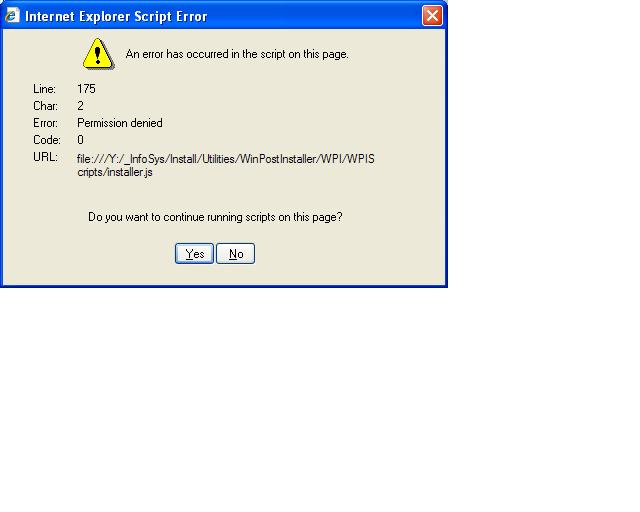
When attempting to run WPI 7.7.0 on Windows XP 32-bit, I keep getting an Internet Explorer Script error "Permission Denied / Line 172 / Char 2 / Code 0 / URL file:///Y:/_InfoSys/Install/Utilities/WinPostInstaller/WPI/WPIScripts/installer.js" This only happens after running the WPI program and installing any single or multiple selections of items first. I am unzipping the program from the download and adding the config.js, useroptions.js, and windowsoptions.js files to the WPI Scripts Folder. I have tried recreating new scripts by going through and recreating my entire install list and groups. I have not edited the code manually. Thanks for any help or insight you can give me. Trmfp New_Config_Files.zip.zip